In industrial environments where presses, press brakes, and forming lines are used, the management of heavy tooling has become a critical factor for both productivity and safety. Dies, punches, and press tools can easily weigh hundreds of kilos and require frequent, precise, and repeatable changeovers.
In this context, assisted handling systems are no longer an accessory and become a strategic element within any modern plant.
At 3ARM, we have spent years developing industrial manipulator solutions specifically designed to meet this challenge: enabling the safe transfer of press tooling, reducing human effort, and improving operational efficiency without compromising precision. Our approach is closely linked to manufacturing ergonomics and the use of advanced lift assist devices.
The real challenge of press tooling handling
Tooling changeovers remain, in many factories, one of the most critical and delicate operations. Not only because of the weight of the tools, but also due to the need to align them correctly, avoid impacts, protect machined surfaces, and ensure the die is perfectly positioned before starting production.
Traditionally, these tasks have been carried out using overhead cranes, forklifts, or even manually with improvised aids. The result is usually the same: long changeover times, dependency on multiple operators, increased risk of musculoskeletal injuries, and a higher likelihood of damage to the tooling itself. This is where the manipulator, understood as an ergonomic motion assistance system, makes a substantial difference.
What are assisted handling systems and how they are applied to presses
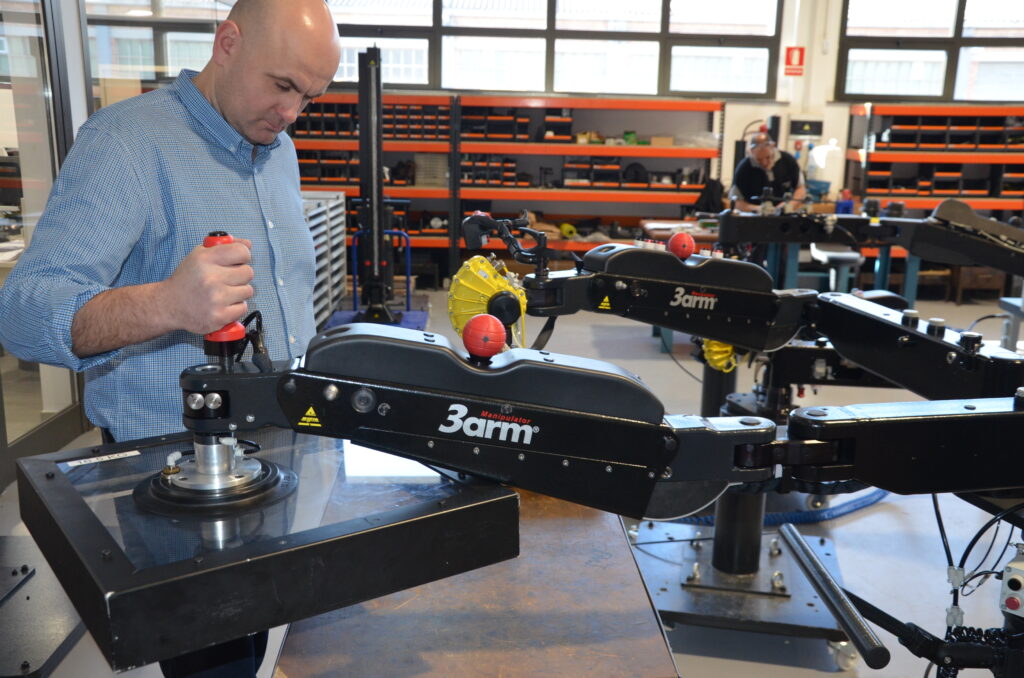
Assisted handling systems are devices designed to accompany the operator’s natural movement, compensating for the load weight and enabling smooth, precise, and controlled maneuvers. Unlike rigid automation, the operator retains full control of the process, without assuming the physical effort or associated risks.
Applied to press tooling, these systems allow:
• Lifting heavy dies and punches with complete stability.
• Moving tooling from storage areas to the press without effort.
• Positioning the tool with millimetric precision.
• Performing quick changeovers even in confined spaces.
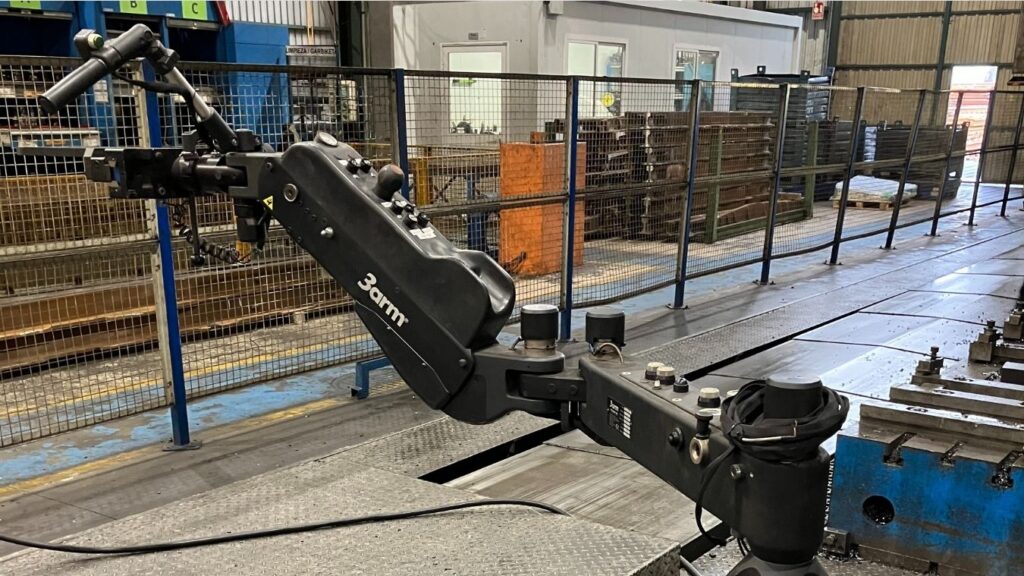
In the case of 3ARM, our articulating arms are designed to integrate directly into the press environment, adapting to the tooling geometry and the real workflow of each customer. Solutions such as an industrial manipulator arm ensure precision while maintaining operator control.
Safe die transfer with assistance and locking
One of the key points in tooling handling is the safe transfer of dies, especially during loading and unloading phases at the press. It is not enough to move the tool; it is essential to ensure that, at all times, the tooling is controlled, stabilized, and protected against involuntary movements.
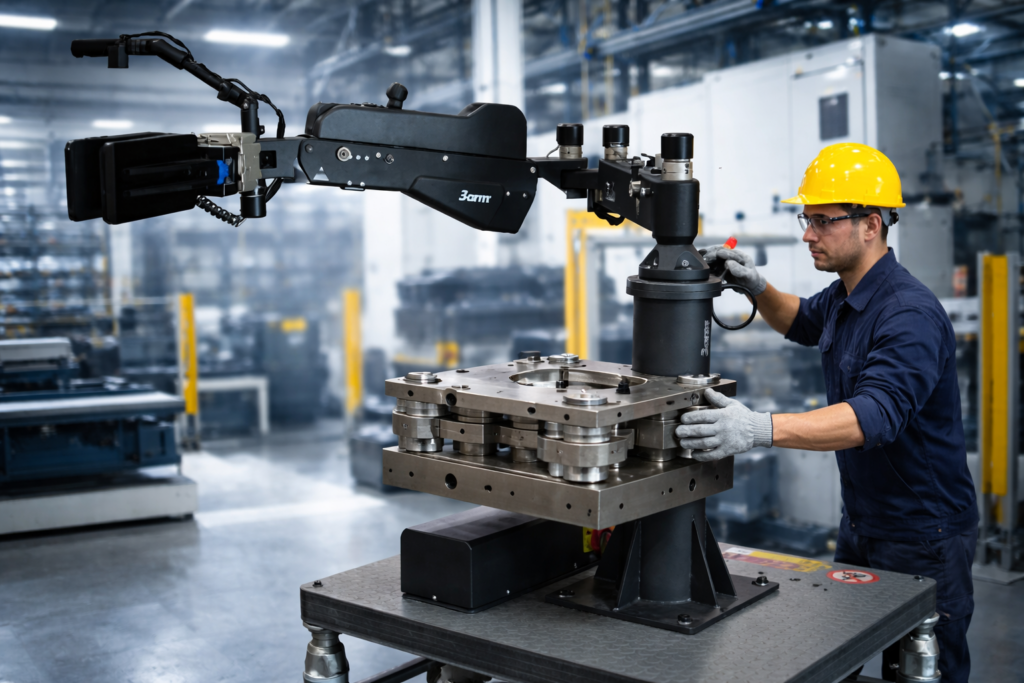
3ARM systems incorporate assistance and locking solutions that provide an additional level of safety and precision. Controlled locking allows the die to be held in a fixed position during critical operations, preventing unwanted rotations or accidental displacement.
This functionality is particularly relevant for large or complex-geometry dies, where even a small movement can cause costly damage or pose risks to the operator.
Thanks to this combination of dynamic assistance and secure locking, the operator can work with confidence, perform fine adjustments, and complete tooling changeovers quickly and repeatably.
Ergonomics and occupational risk prevention in industrial companies
Ergonomics is no longer just a matter of well-being, but a fundamental pillar of occupational risk prevention in industrial companies. Overexertion injuries, especially to the back, shoulders, and arms, remain one of the main causes of sick leave in production environments.
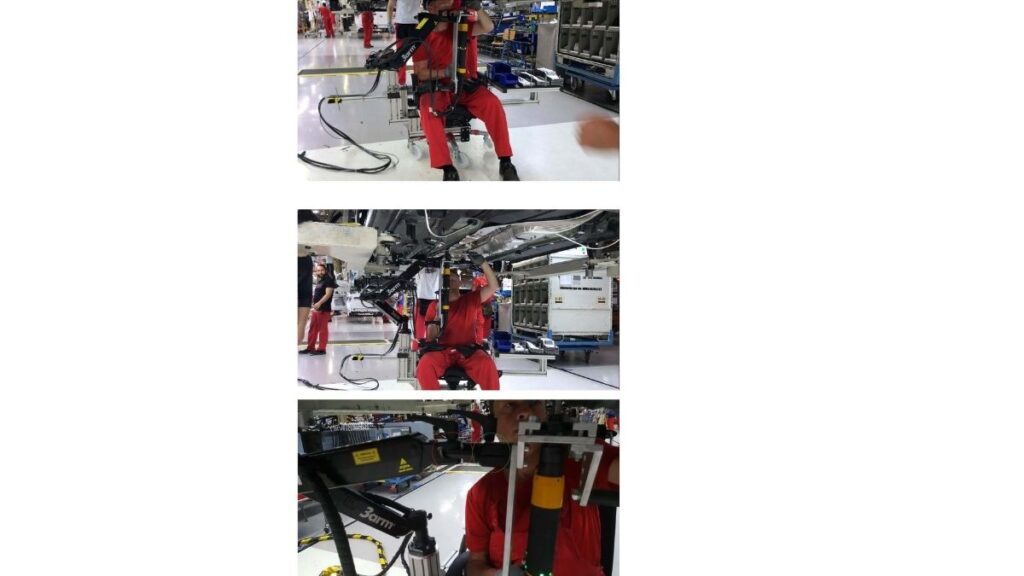
A well-designed industrial manipulator virtually eliminates the need to lift, push, or hold heavy loads. Physical effort is reduced to a minimum, and movement becomes natural and intuitive. This not only protects the worker, but also allows personnel with different physical capabilities to perform the task with the same level of safety and efficiency. In this sense, ergonomic lifting devices play a key role.
From a business perspective, the impact is clear: fewer absences, greater operational continuity, improved workplace climate, and effective compliance with safety regulations.
Direct impact on productivity and quality
Beyond safety, assisted handling systems have a direct effect on productivity. Reducing tooling changeover time means increasing actual press availability and facilitating short production runs or frequent reference changes.
The precision provided by a manipulator also translates into better process quality. By avoiding impacts, misalignments, or forced adjustments, tooling lifespan is extended and rework associated with assembly errors is reduced. In demanding sectors such as automotive, aerospace, or high-precision machining, this factor is decisive.

The 3ARM value proposition in tooling handling
At 3ARM, we design custom assisted handling solutions, always starting from a real analysis of the customer’s process. The goal is not to adapt the operation to the equipment, but to design the assisted handling system that best fits the tooling, the press, and the available space.
Our manipulators stand out for:
• High load capacity with full control of movement.
• Gripping and locking systems adapted to press dies.
• Ergonomic design focused on the operator.
• Simple integration into existing lines.
• Reliability and durability in demanding industrial environments.
With international presence and projects in highly regulated sectors, 3ARM has established itself as a trusted technology partner for companies seeking to improve safety, efficiency, and competitiveness.
Strategic investment, not just equipment
Investing in assisted handling systems for press tooling is not only a technical decision, but a strategic commitment to safety, productivity, and business sustainability. The combination of motion assistance, safe die transfer, and locking systems turns the manipulator into a key tool within the modern factory.
If your company works with presses and regularly handles heavy tooling, now is the time to move forward.
Contact 3ARM and discover how our industrial manipulators can transform your tooling changeover process, improve occupational risk prevention in your company, and take your productivity to a new level.