The selection of an industrial articulating arm does not usually begin in a catalog, but at the workstation itself. This is where the key questions arise: what torque must the system withstand? how does the actual weight of the tool affect performance? what happens with reactive torque? what working radius is really needed? how does everything integrate with the screwdriver?
These questions are not theoretical. They respond to real production challenges where tool handling directly affects both tightening quality and operator efficiency. Incorrect sizing not only limits performance, but also introduces operational and ergonomic risks that are difficult to correct later.
What torque must the articulating arm withstand?
The first critical point in any selection process is the maximum application torque. In engine tightening, this value is usually clearly defined by process engineering, but the common mistake is to size the system exactly at that limit.
In practice, any articulating arm must operate with a safety margin that absorbs dynamic variations, load peaks and real working conditions. Therefore, it is recommended to apply safety factors between 1.5 and 2 times the nominal torque, a widely used criterion in industrial tightening control solutions such as torque arms.
Imagen sugerida por el cliente: 3arm-Manipulator-M5.psd
How is weight compensation correctly calculated?
One of the most underestimated aspects when selecting a tool support system is the actual weight of the assembly. It is not just about the screwdriver; the calculation must include all associated elements: sockets, extensions, batteries, cables or hoses. This total load defines the system’s behavior during movement and directly affects positioning accuracy.
In advanced industrial applications, this type of analysis aligns with criteria used in sizing robotic systems, where the relationship between load and reach is critical for overall performance. Ignoring this interaction often results in imprecise movements, accumulated fatigue or loss of control at the tightening point. In these cases, solutions such as a tool balancer can help manage the load more efficiently.
How to manage reactive torque without compromising precision?
Reactive torque is one of the most critical factors in high-torque tightening applications. If not properly managed, it is directly transferred to the operator, causing deviations, misalignment and, in the worst cases, threading errors. This is where the design of the industrial articulating arm makes the difference.
Systems must be able to absorb this torque without introducing excessive rigidity or limiting mobility. In this sense, the most advanced solutions integrate mechanisms that dissipate the load while maintaining tool alignment, a key factor to ensure tightening quality and avoid defects such as cross-threading.
What working radius is really necessary?
Operational reach is another factor often underestimated in early stages. In engine assembly, tightening points are rarely located on a single plane. This requires working at different heights, depths and angles, demanding a system capable of covering the entire working volume without creating constraints.
A properly sized articulating arm must allow smooth movement in three dimensions, always maintaining stability and control. The key is not only reaching the point, but doing so repeatedly, without additional effort and without compromising alignment. This is where system geometry and its ability to adapt to the workspace become critical, especially in solutions like an industrial manipulator.
How does the arm integrate with the screwdriver?
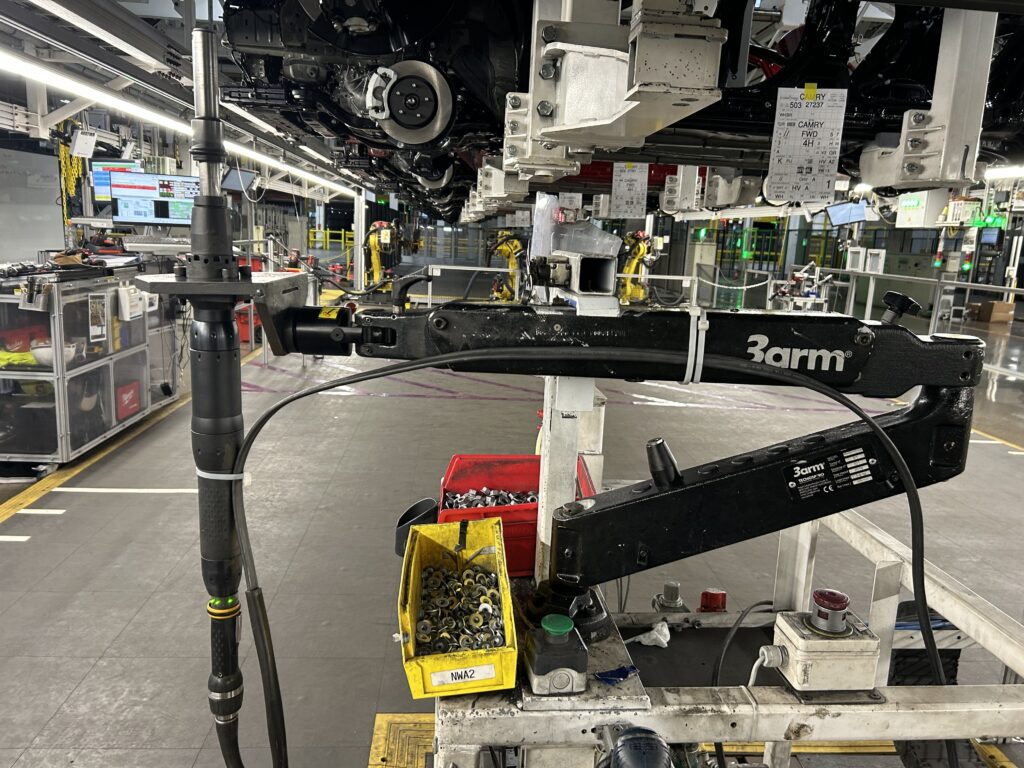
The integration between the industrial articulating arm and the fastening system is a critical aspect that goes beyond mechanical compatibility. It is necessary to ensure that the assembly works as a coherent unit, where the tool can be positioned precisely, without interference and with predictable response in every cycle.
This involves considering aspects such as axis orientation, cable management, accessibility to tightening points and interaction with other workstation elements. A proper design allows tool handling to feel natural, reducing cycle times and improving the operator experience, especially when supported by ergonomic lifting devices.
Ergonomics in manufacturing: a technical factor, not optional
Ergonomics in manufacturing should not be understood as an add-on, but as a technical variable that directly influences system performance. Reducing effort, improving posture and eliminating unnecessary loads not only prevent injuries, but also allow consistent precision levels throughout the shift.
Specialized occupational health organizations have shown that proper workstation adaptation significantly reduces fatigue and improves productivity in industrial environments. In this context, the tool support system becomes a key element in process optimization.
The value proposition of 3ARM
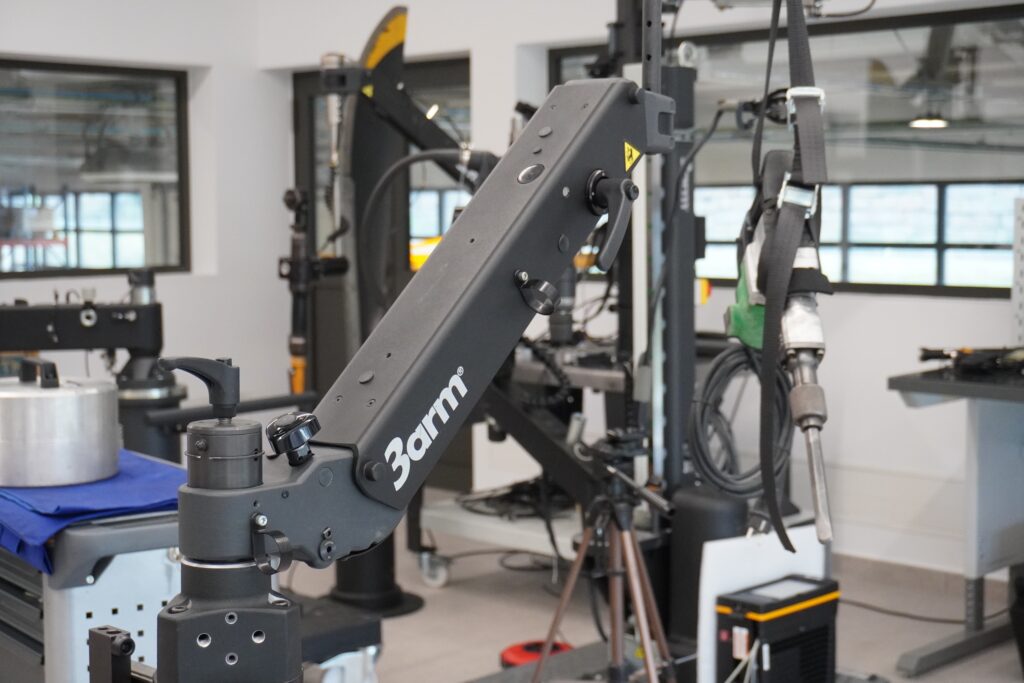
In high-torque and high-demand applications, conventional systems often fall short. 3ARM solutions are designed to address these limitations through an approach that integrates weight compensation, torque absorption and freedom of movement into a single system.
This allows working with heavy tools or under complex conditions while maintaining control, precision and ergonomics. The result is more efficient tool handling, elimination of physical strain on the operator and a direct improvement in process quality.
Proper sizing means better production
Selecting the right industrial articulating arm is not a minor decision. It is a process that requires a deep understanding of real working conditions and the application of engineering criteria that ensure long-term performance.
Do you need help sizing your system?
At 3ARM, we help industrial companies optimize their assembly processes through advanced articulating arm and tool support solutions. If you are working on an engine tightening application and need to ensure precision, ergonomics and reliability, our team can support you throughout the sizing process.
Contact 3ARM and discover how to improve the efficiency of your assembly line from the very first tightening point.